
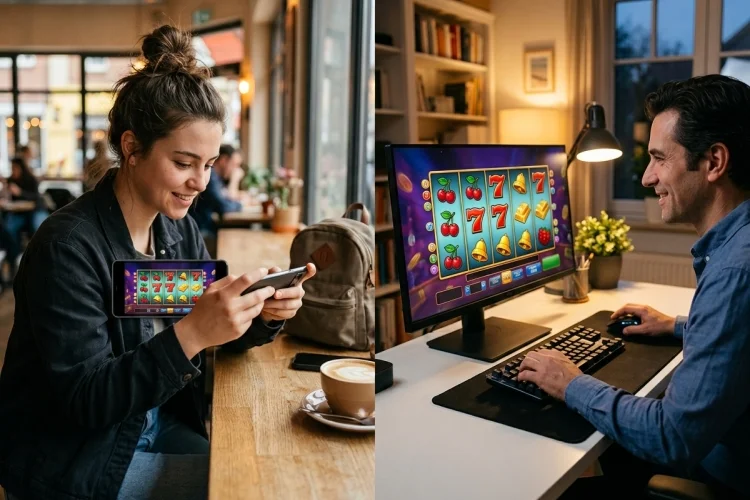
A slot may look different when opened on a six-inch phone instead of a twenty-four-inch monitor. Buttons move, menus shrink, reel dimensions change, and some animations may be simplified. But does anything important happen beneath the surface?
The Mobile Slots vs Desktop Slots debate becomes more interesting when you separate presentation from game mathematics. Modern casino software can adapt visually to different devices while keeping the underlying rules intact.
Performance, battery use, network stability, interface design, and accessibility can still differ considerably, making the two formats worth comparing beyond simple convenience.
Responsive Design Changes the Interface, Not Necessarily the Game
Modern online slots are commonly built to function across multiple screen dimensions.
Responsive design allows the page or application interface to rearrange itself according to available space.
A desktop version might display several controls beside the reels, while the mobile layout places those options inside a menu.
Google’s responsive-design guidance explains that websites can change from multi-column desktop layouts to simpler mobile layouts while keeping the same underlying content.
MDN similarly defines responsive web design as adapting layouts to different screen sizes and resolutions while maintaining usability.
The graphics may therefore appear different without requiring a completely different game engine.
That distinction is important when comparing devices.
RNG Results Should Not Depend on Screen Size
For regulated RNG casino games, randomness comes from the game system rather than the dimensions of your display.
UK Gambling Commission requirements state that random outputs must be unpredictable and distributed according to expected theoretical probabilities. They also prohibit undisclosed adaptive behaviour that changes probabilities based on previous play.
In practical terms, pressing Spin with your thumb instead of clicking a mouse should not create a different category of probability merely because you are using a phone.
The device sends the game request, and the gaming system processes the event according to the applicable rules.
Your screen then presents the outcome.
Animation is therefore presentation. The game result is the underlying event.
Does RTP Change Between Mobile and Desktop?
RTP stands for return to player.
It represents the designed long-run percentage returned as prizes according to the game’s mathematical model.
The UK Gambling Commission defines theoretical RTP as the designed percentage associated with the game and distinguishes it from actual RTP measured from operational turnover and prizes.
Switching devices does not by itself create a new RTP.
However, you should still check the paytable on each platform.
A provider or operator could potentially offer different configured versions of a title, provided applicable rules and changes are properly communicated.
The key factor is therefore the exact game version—not whether the pixels happen to appear on Android, iPhone, or desktop.
If the displayed rules and RTP match, there is no reason to assume the mobile device secretly has worse odds simply because it is smaller.
Performance Depends on Hardware and Browser Quality
One device may run a slot beautifully while another struggles.
That does not necessarily mean mobile software is inferior.
Modern phones contain powerful processors and graphics hardware. At the same time, a desktop can offer more memory, better cooling, and fewer battery restrictions.
Browser quality matters too.
An outdated mobile browser may render a game poorly, while a current browser can handle modern web technologies much more effectively.
The reverse can happen on old desktop hardware.
For this reason, raw device age and specifications often matter more than the category of device.
Slow performace may produce delayed animations or loading, but that should not alter the rules of a correctly implemented casino game.
UK standards require game systems to process outcomes according to published rules under normal operation.
Screen Space Can Change How Easy Rules Are to Read
One underestimated desktop advantage is information density.
Slots often include detailed paytables explaining wilds, scatters, multipliers, jackpots, bonus triggers, and maximum prizes.
On a desktop screen, more of this information can be displayed simultaneously.
Mobile interfaces typically hide secondary information behind menus to preserve reel space.
That does not necessarily make the mobile experience worse. In fact, a properly designed interface can feel much cleaner.
But players should still open those menus.
UK remote gaming standards require relevant rules and information about the likelihood of winning to be available to customers.
A smaller screen is not a good reason to ignore the paytable.
The information remains more important than the device used to view it.
Network Stability Can Differ More Than Game Performance
Desktop users frequently rely on home Wi-Fi or Ethernet.
Phones may move between Wi-Fi, 4G, and 5G during the same session.
That mobility makes connection quality more variable.
UK Gambling Commission standards recognise that slower network speeds and device performance can matter in time-critical events and require operators to consider the risk where response speed affects outcomes.
Most standard slot spins are not about physically clicking faster than another player.
Still, connection instability can affect loading and the ability to see the result immediately.
Server-side game records remain important because what appears on the player’s screen can be interrupted even after the gaming system has received the wager.
A Disconnection Does Not Automatically Cancel a Spin
Suppose you tap Spin on your phone and immediately lose signal.
Did the spin happen?
The answer depends on whether the server received the wager before the interruption.
UK rules on interrupted gambling state that when the operator has received the customer’s gamble and the customer has no further influence over the outcome, the result should generally stand. If a single-stage outcome has not yet been generated, the deducted stake should be returned.
This principle applies to the underlying transaction rather than the device.
A desktop browser crash can create the same issue as a lost cellular connection.
Players should therefore check game history or account records after an interruption instead of repeatedly pressing Spin.
Mobile Can Require More Battery Management
A desktop computer does not need to conserve energy in the same way as a phone.
Mobile operating systems may reduce background activity and visual performance when battery-saving modes are enabled.
Android says Battery Saver can restrict background activity, visual effects, network functions, and some application behaviour.
Apple’s Low Power Mode can reduce refresh rates on supported displays, background refresh, automatic downloads, and some visual effects.
These settings generally affect presentation and system responsivness rather than changing casino mathematics.
Still, they can make animations feel different.
If a mobile slot suddenly looks less smooth on a low battery, power-management settings may be the reason.
Mobile Data Is Another Variable Desktop Players Rarely Notice
Desktop sessions normally use an unlimited or relatively generous fixed internet connection.
Mobile play may consume a limited cellular allowance.
Modern responsive design can reduce this burden by serving smaller images and layouts better suited to narrow devices. MDN specifically notes that smaller screens often benefit from smaller image downloads because mobile users may have slower or more expensive connections.
Phones also include data-saving controls.
Apple’s Low Data Mode reduces background network use and automatic downloads.
This can make mobile play practical even on limited plans, although downloading large app updates or extensive game assets is still better suited to Wi-Fi.
Game Libraries May Not Be Completely Identical
Most modern HTML5 slots are designed for multi-device compatibility.
Still, a casino’s mobile and desktop libraries can occasionally differ.
Older games may have been built around obsolete desktop technologies or unusual aspect ratios that were never redesigned for touchscreens.
Newer responsive titles generally handle the transition much better.
Do not therefore assume that a game missing from your phone has necessarily been removed from the casino entirely.
It may simply be unavailable on that specific platform.
Likewise, some mobile applications can contain a different selection from the browser version because of technical or platform requirements.
This is a content-delivery difference rather than proof of different odds.
Security Matters on Both Platforms
Both formats handle sensitive account information.
A desktop may face browser malware, phishing, stolen passwords, or unsafe extensions.
Phones can face similar threats through malicious applications, phishing messages, or stolen devices.
The UK Gambling Commission applies security requirements to critical remote gambling systems processing authentication information, payment details, and account balances. These requirements are based on relevant controls from ISO/IEC 27001:2022.
Players still need good habits on their own devices.
Use unique passwords, enable stronger authentication where available, keep software updated, and verify the operator before logging in.
Neither mobile nor desktop is automatically secure just because of the form factor.
Which Device Should You Use?
Choose based on the environment rather than assuming one platform changes the odds.
Mobile works well for portability, quick access, and touch-based controls.
Desktop is useful when you want a larger screen, easier rule reading, stable power, and more space for multiple windows.
If you use both, check that you are opening the same game configuration and review its RTP and paytable.
The mathematical information tells you far more than the physical size of the device.
Your phone may change how the slot looks.
It should not secretly recaluclate the game simply because the display became smaller.
The technical side of Mobile Slots vs Desktop Slots shows that device choice mainly affects presentation, performance, connectivity, and convenience. A properly regulated RNG game should follow its published rules and probabilities regardless of screen size.
Compare the exact RTP and paytable, keep your device updated, and choose the platform that gives you the clearest, most stable experience rather than assuming one offers better odds.