
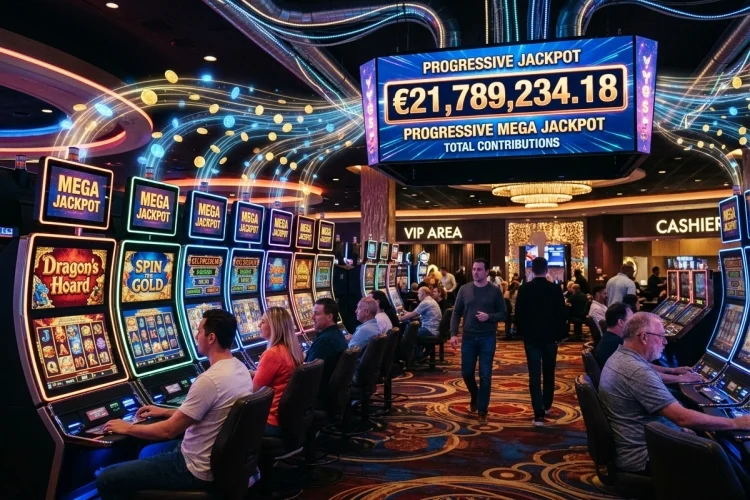
A progressive jackpot reaching several million dollars naturally raises one question: where does all that prize money come from? It is not simply placed there overnight by the casino.
Behind Progressive Jackpot Slots is a system that tracks eligible wagers, contribution percentages, jackpot tiers, starting values, and network activity. Some progressives run on a single platform, while others connect games across much larger networks.
The result is a prize meter that can keep climbing until somebody triggers the winning event. Here is what actually happens behind that counter.
The Jackpot Counter Is Connected to Real Accounting
A progressive counter is more than a decorative animation.
The gaming platform needs to track the current jackpot value and the transactions contributing to it.
GLI standards for interactive gaming systems include reporting requirements covering progressive pool names, eligible wagers, contribution parameters, jackpot amounts won, startup seeds, diverted contributions, and current pool values.
In other words, the operator needs a record explaining why the meter displays the number it does.
That record keeping becomes especially important for large networked jackpots.
A discrepancy of even a fraction of a percentage could become significant when millions of wagers are processed.
Eligible Wagers Feed the Progressive Pool
The fundamental mechanism is straightforward.
A small portion of qualifying wagers contributes toward the progressive system.
Imagine a hypothetical network receiving 500,000 eligible $1 wagers in one day.
If 0.5% of those wagers feeds the displayed jackpot, the contribution would total $2,500.
Real jackpot designs can use completely different percentages, wager structures, and mathematical models, so this example is only illustrative.
What matters is that the contribution rate is defined in advance.
GLI progressive standards list the increment percentage as a core configuration parameter, together with reset values, ceilings, and secondary or hidden increments.
The prize therefore grows systematically rather than randomly.
A Jackpot Can Have Several Prize Levels
Many modern progressives do not have only one jackpot.
They can include multiple tiers such as Mini, Minor, Major, or Grand.
Each level may have its own starting value, contribution rate, trigger rules, and maximum amount.
A smaller jackpot might be awarded more frequently, while the top progressive can be significantly rarer.
This structure allows a single game to distribute progressive value across several prize pools.
Behind the screen, the platform may be tracking those pools seperately even though they appear together on the game interface.
The mathematical contribution allocated to one level therefore does not necessarily go into another.
Always check the rules because similar tier names can work differently between games.
Local and Networked Jackpots Grow at Different Speeds
The size of the participating player base can have a major influence on how quickly the displayed prize grows.
A local jackpot might receive contributions from games inside one casino platform.
A wider linked jackpot can connect many gaming instances.
The more eligible wagering activity moving through the system, the faster the meter can potentially increase.
Wide-area progressive systems exist specifically to connect many gaming devices or terminals to a shared prize. IGT describes a system in which compatible devices can participate under one progressive jackpot umbrella.
Online networks can achieve a similar effect by linking participating games through centralized infrastructure.
This is how tiny individual contributions can eventually produce extremely large totals.
Seed Money Prevents the Prize From Returning to Zero
Imagine someone winning a $4 million jackpot and the counter instantly dropping to $0.
That would not be very attractive, and it is not how many progressives are structured.
Instead, a preset startup value or reset value establishes the next prize.
A jackpot might therefore fall from $4 million back to $500,000 after being awarded.
UK technical standards say jackpot rules should disclose how the prize is funded along with the startup seed and any ceiling values.
GLI’s technical framework also distinguishes between initial jackpot values, reset values, and startup seeds that are not funded directly from player contributions.
The reset therefore represents a planned part of the system rather than money appearing unexpectedly.
Hidden Increment Pools Can Prepare the Next Jackpot
This is where progressive jackpot accounting becomes more interesting.
Not every contribution necessarily appears on the public meter.
A system may divert part of the contribution into a separate reserve pool.
Suppose a jackpot starts at $1 million.
A provider may need funds available to maintain that starting value after the current prize is awarded. A hidden or diversion pool can help support that reset.
GLI-12 describes a Jackpot Diversion Scheme where some progressive contributions are directed into another pool. That reserve can be used for purposes such as funding the next reset or managing simultaneous jackpot awards.
This does not mean money disappears.
It means the accounting can involve multiple connected pools instead of one single visable counter.
The Jackpot Trigger Is Separate From Prize Growth
This distinction causes a lot of confusion.
The progressive meter determines what the jackpot is worth.
The trigger mechanism determines when somebody wins it.
Those are related parts of the same game, but they are not identical.
Depending on the design, the jackpot could be triggered through a specific symbol combination, a bonus feature, or another RNG-based event.
GLI standards include explicit requirements around jackpot odds, including jackpots triggered inside bonus features and linked jackpot systems.
Regulated testing also checks whether progressive jackpots increment and trigger according to the stated rules.
A rapidly growing meter does not therefore mean the software is moving closer to an inevitable win unless the game rules specifically define such a relationship.
Linked Systems Need Accurate Synchronization
A network jackpot creates another technical challenge.
Thousands of players may be contributing at nearly the same time.
The central jackpot system must keep the displayed value accurate while processing eligible wagers from multiple connected games.
It also needs to handle interruptions.
GLI progressive standards include requirements for recovering system state after interruptions and securely maintaining jackpot configuration information.
That means the progressive total cannot simply depend on what happens to be displayed on one player’s device.
The authoritative pool information is maintained by the gaming infrastructure behind the interface.
What Happens If Two Players Trigger the Jackpot Together?
Network latency makes this an interesting problem.
Imagine two players in different locations appearing to hit the same jackpot almost simultaneously.
Which one wins?
The answer should already exist in the jackpot rules and system design.
UK Gambling Commission standards state that jackpot rules should explain how prizes are awarded when two or more players simultaneously, or apparently simultaneously, trigger the same progressive jackpot.
That requirement shows why accurate timestamps, transaction records, and central processing matter.
A large jackpot network needs more than good graphics; it needs a reliable way to establish the correct winning event.
Jackpot Caps Need Somewhere for Extra Contributions to Go
Some jackpots have a maximum value.
Suppose the Grand jackpot cannot exceed $20 million.
Once that ceiling is reached, additional contributions cannot simply keep increasing the displayed prize.
The game’s rules need to specify what happens next.
Funds may be redirected into a reserve, overflow pool, or another defined area of the jackpot system.
UK technical guidance specifically calls for operators to explain how contributions are handled once a jackpot hits its ceiling.
GLI standards also track ceiling values, secondary increment rates, overflow amounts, and diversion pools.
That makes the maximum jackpot part of the wider mathematical configuration rather than an arbitrary marketing number.
Very Large Jackpots Bring High Volatility
A multimillion-dollar jackpot may dominate the marketing, but it represents a rare event.
That creates high variance.
The UK Gambling Commission notes that progressive jackpots can be so infrequent and large that their performance may need to be monitored separately from the base game.
Frequency, distribution, and average jackpot levels can be used to assess whether the system is behaving as expected.
This is worth remembering when reading RTP figures.
A portion of theoretical return can be concentrated in extremely rare prizes.
A huge jackpot therefore should not be interpreted as evidence that an individual session has better short-term winning chances.
Progressive Jackpot Slots turn many small qualifying contributions into potentially huge prize pools. Behind the counter are seed values, contribution rates, jackpot tiers, network connections, reserve funds, and carefully defined trigger rules.
The displayed prize is only one part of that system. Before playing, review the jackpot rules, eligible wager requirements, trigger conditions, and RTP information so you understand how the prize is funded and awarded.