
Author: Isabela Moreira

Casino Strategy

How to Build a Professional Bankroll Management System for Casino Play

Good bankroll management starts long before the first card is dealt or the first wheel begins spinning. Without a clear structure, even modest bets can grow quickly when losses, winning streaks, and emotions start influencing decisions.

A professional Bankroll Management System creates boundaries around how much capital is available, how much can be risked per wager, and when a session should end. It cannot overcome a casino’s mathematical advantage, but it can make exposure easier to measure and control. The aim is simple: decide the financial rules first, then play within them rather than rewriting them during the session.

Define Your Bankroll Before Defining Your Bets

The first step is separating gambling money from money needed for normal living expenses.

Your bankroll should be a predetermined entertainment allocation rather than cash reserved for bills, savings goals, debt payments, or emergencies. NCPG guidance recommends establishing financial and time limits before gambling and sticking to them rather than chasing losses.

Split the Total Budget Into Sessions

Imagine you have allocated $600 for casino entertainment over a longer period.

Putting the full $600 into one session creates far more exposure than dividing it into six $100 sessions. The second approach gives every session an independent financial boundary.

That does not make any game more likely to pay.

It simply prevents one bad sequence from automatically consuming the entire allocation.

A professional system treats these boundaries as fixed operating rules, not suggestions that disappear when the balance falls.

Convert the Bankroll Into Betting Units

After determining the session bankroll, calculate a base unit.

A unit is your normal wager expressed as a fraction of available capital.

Suppose your session bankroll is $500. A $5 wager represents 1% of that bankroll and gives you 100 starting units. A $25 wager represents 5% and leaves only 20 units.

Unit Depth Shows Bankroll Fragility

Consider ten consecutive losing base wagers.

At $5 each, the decline is $50, or 10% of the original bankroll. At $25 each, the same ten-loss sequence removes half of it.

The probabilities of the underlying game have not changed.

Only your exposre has.

This is why professionals think in percentages and units rather than choosing stakes because they simply “feel comfortable.”

Match Unit Size to Game Volatility

Not all casino wagers fluctuate in the same way.

Some produce frequent small results, while others lose much more often before occasionally delivering a larger payout. For RTP-based games, the UK Gambling Commission notes that actual results can move above or below theoretical return over shorter samples, and the permissible range is influenced by game volatility.

Higher Volatility Needs More Breathing Room

Imagine two games with comparable theoretical expected costs.

Game A creates relatively steady balance movement. Game B produces longer losing sequences and occasional large wins.

Using 20 bankroll units on Game B is far more fragile than using 100 or 200.

A sensible system therefore allows stake size to change when the volatility profile changes.

The aim is not to eliminate variance—that is impossible. It is to avoid combining an already volatile game with an unnecessarily agressive wager size.

Include House Edge in Game Selection

Bankroll management is not only about bet size.

The mathematical cost of the wager matters too.

The UK Gambling Commission defines house edge as the percentage a casino expects to retain, on average, from hands or spins under normal patterns of play.

Translate Percentages Into Expected Cost

Imagine two hypothetical games.

Game A carries a 1% house edge. Game B carries 5%.

Across $2,000 of comparable wagering turnover, their theoretical expected costs are approximately $20 and $100.

Your actual session might finish far above or below those amounts, because house edge is not a short-term prediction.

However, lower-edge conditions generally reduce expected cost when wagering volume is held constant.

A strong Bankroll Management System therefore combines money management with sensible game selection rather than trying to manage a bankroll while repeatedly choosing expensive bets.

Create a Maximum Exposure Per Round

One of the easiest bankroll mistakes is counting only the main bet.

Suppose you wager $20 on baccarat and add two $5 side bets.

Your actual exposure is $30.

The same issue appears in roulette when several small chips are spread across numbers, dozens, and outside bets.

Count Every Chip

Set a maximum total amount that can be placed during one round.

If your standard round limit is $10, optional bets must fit inside that $10 rather than being added afterward.

This prevents “just a small side bet” from quietly turning a controlled session into a much more volatile one.

It also encourages you to compare optional bets independently instead of assuming they have the same mathematical conditions as the main wager.

Track Turnover Alongside Profit and Loss

Starting bankroll and final balance tell only part of the story.

Turnover measures how much total money has passed through wagers.

The UK Gambling Commission calculates actual RTP by dividing game wins by total turnover, illustrating why repeated wagering volume is a central part of casino mathematics.

Small Bets Can Produce Large Turnover

A $5 wager repeated 100 times creates $500 of betting action.

Repeat it 1,000 times and total turnover reaches $5,000.

This explains why a seemingly conservative stake can still create considerable long-term exposure when the session is very long or the game is extremely fast.

A professional record should therefore track approximate rounds, average stake, and total turnover—not merely whether the session finished up or down.

Build Drawdown Rules Into the System

A drawdown is the decline from your starting or peak bankroll.

Suppose you begin with 100 units and establish a maximum session drawdown of 30 units.

Reaching 70 units ends the session.

Drawdown Limits Are Behavioural Controls

A stop rule does not alter the probability of the next result.

Its purpose is preventing a difficult sequence from triggering larger bets or additional deposits.

This becomes especially useful because the percentage represented by a fixed wager rises as the bankroll falls.

A $10 wager equals 2% of a $500 bankroll. If the balance drops to $250, it suddenly represents 4%.

Continuing unchanged makes the system increasingly agressive without changing the nominal bet.

Reducing the unit or ending the session prevents that hidden risk escalation.

Never Build Recovery Into the Plan

Professional bankroll management should not require recovering previous losses.

Once a session reaches its predetermined limit, the loss belongs to that completed session.

GamCare advises tracking gambling spend and establishing a clear budget, while NCPG guidance explicitly warns against chasing losses.

Recovery Targets Distort Decision-Making

Suppose a $300 bankroll falls to $150.

If the goal suddenly becomes “get back to $300,” you may increase stakes or extend play beyond the original plan.

The house edge has not improved because you are behind.

The only thing that changes is your urgency.

A professional system accepts that individual sessions can end negatively and keeps the next session seperate from the previous one.

Review the System Using Process Metrics

A winning session is not automatically a well-managed session.

Likewise, a losing session is not proof that the framework failed.

After playing, record your starting bankroll, normal unit, largest wager, approximate turnover, largest drawdown, and finishing balance.

Then ask whether you followed the rules.

If you planned $5 units but repeatedly increased to $20 after losses, the process needs improvement even if you eventually finished ahead.

Long-term discipline is better measured by adherence to your framework than by one lucky result.

A professional Bankroll Management System combines a dedicated budget, percentage-based units, volatility awareness, game selection, turnover tracking, and predefined drawdown limits. These controls cannot remove house edge or guarantee profit, but they can keep gambling exposure measurable and deliberate.

Before your next session, write down the bankroll, base unit, round limit, and stopping point—and treat those numbers as rules rather than targets to renegotiate.

Casino Games

How to Play Blackjack Efficiently Under Changing Table Rules

Blackjack strategy becomes much more interesting once you realise that the “correct” play is not always universal. A hand that should be doubled at one table may be a simple hit at another because the dealer rules, deck count, or available options have changed.

Learning How to Play Blackjack efficiently therefore means reading the table before memorising individual moves. Blackjack payout, soft 17, surrender, doubling after splits, and deck structure all influence expected return. Rule awareness will not guarantee a winning session, but it can prevent small strategic mistakes from being repeated hundreds of times.

Start With the Rules Before Looking at Your Cards

One of the biggest efficiency improvements in blackjack happens before the first hand is dealt.

The exact rule combination determines both the house edge and the basic-strategy chart you should use. Blackjack calculators commonly require inputs for deck count, dealer soft-17 behaviour, doubling after split, surrender, resplitting, and several other conditions because these factors alter expected results.

Build a Quick Table Profile

Before placing a bet, check:

blackjack payout, number of decks, S17 or H17, double-after-split availability, surrender, and restrictions on splitting aces.

You do not need to calculate the house edge manually every time. The important habit is recognising that a six-deck H17 game is not strategically identical to a six-deck S17 game.

The UK Gambling Commission also requires casino rules and house-edge information to be made available in regulated British casino environments, reinforcing why table conditions are relevant player information.

Treat 3:2 Blackjack as a Major Table Filter

Blackjack payout deserves attention before almost every other detail.

Traditional blackjack commonly pays 3:2 for a natural, while some tables use the less favourable 6:5 structure.

The Difference Is Larger Than It Looks

On a $20 wager, a 3:2 natural pays $30 in profit. At 6:5, the profit is only $24.

Wizard of Odds estimates that replacing 3:2 with 6:5 costs the player around 1.36 percentage points in expected return under its example assumptions.

That is a meaningful change compared with many smaller blackjack rule adjustments.

An efficient player therefore does not choose a table solely because its minimum stake is attractive. A cheap table with poor blackjack payouts may have worse mathematics than a slightly higher-minimum game with stronger rules.

Adapt to Dealer Soft 17 Rules

Soft 17 means the dealer holds a hand such as ace-six, where the ace can currently count as 11.

Some tables require the dealer to stand. Others require another card.

H17 and S17 Need Different Strategy Charts

Dealer hitting soft 17 generally increases the house advantage compared with otherwise similar rules. Wizard of Odds lists the H17 change as reducing player expected return relative to its S17 reference game.

The rule can also change individual player decisions.

For example, multi-deck strategy charts contain different actions depending on whether the dealer hits or stands on soft 17. Wizard of Odds publishes separate charts for these conditions rather than treating them as interchangeable.

That means your decison on a borderline double, surrender, or soft hand should come from the chart matching the actual table.

Understand Why Double After Split Matters

Doubling is valuable because it lets you increase the wager when a favourable situation appears.

Double after split, usually shortened to DAS, extends that opportunity to hands created after splitting a pair.

DAS Can Change the Original Split Decision

Imagine splitting a pair and receiving a card that creates a strong doubling total.

If DAS is available, the new hand may give you an opportunity to increase the stake under favourable circumstances. Without DAS, that option disappears.

This is why pair strategy can change depending on whether DAS is permitted. Blackjack strategy tools specifically ask for this rule when generating the appropriate chart.

Efficient blackjack is not only about choosing the best action now. It also considers which future actions become available after the current move.

That branching structure is what makes blackjack more mathemtical than simply trying to reach 21.

Use Surrender When the Mathematics Supports It

Surrender can feel like giving up, but mathematically it is simply another possible action.

Late surrender generally allows you to abandon a qualifying hand and lose half your original wager rather than playing the entire hand.

Some Bad Hands Are Better Abandoned

Certain combinations against strong dealer cards have sufficiently poor expected outcomes that surrender can be preferable to hitting or standing.

Wizard of Odds publishes rule-specific surrender guidance and notes that the correct surrender decision can even depend on whether the dealer hits soft 17 and whether DAS is available.

The key is to avoid emotional interpretation.

You are not surrendering because the dealer “looks strong.” You are choosing the action with the better expected result among several unattractive alternatives.

When the table does not offer surrender, return to the appropriate hit-or-stand strategy instead.

Adjust for Deck Count Without Oversimplifying It

Fewer decks can improve certain aspects of blackjack mathematics because removing one card has a larger proportional effect on what remains.

Wizard of Odds demonstrates that house edge changes across one-, two-, four-, six-, and eight-deck games when the rest of the rules are held constant.

Fewer Decks Do Not Automatically Mean a Better Table

A single-deck game can still be unattractive if it pays 6:5 or imposes restrictive doubling rules.

Likewise, a six-deck game with 3:2 blackjack, S17, DAS, and surrender may have a stronger overall package than a superficially appealing single-deck table.

Compare rules as a bundle.

Deck count is one variable, not a shortcut for evaluating the entire game.

This keeps table selection more consistant and prevents one favourable-looking feature from distracting you from several unfavourable ones.

Pay Attention to Split and Resplit Restrictions

Splitting rules extend beyond whether you can divide a pair once.

Some tables allow resplitting to several hands. Others restrict resplitting aces or give only one additional card to each split ace.

Rare Rules Still Affect Expected Return

These situations do not occur every session, but blackjack house-edge calculators treat resplitting, split aces, and additional cards to split aces as distinct variables.

That means they have mathematical value even if their individual effect is relatively small.

Advanced efficiency comes from stacking many small improvements together.

You might save only a tiny fraction of expected return from one liberal splitting rule, but combining favourable splitting, doubling, payout, and dealer rules can create a noticeably better table than the restrictive alternative.

Evaluate each condition seperately, then consider the complete package.

Match Your Basic Strategy to the Exact Table

The final step is straightforward: use the strategy designed for the game you are actually playing.

Wizard of Odds offers different strategies for single-deck, double-deck, four-or-more-deck, and other blackjack configurations precisely because rule differences can change optimal actions.

Accuracy Beats Complexity

You do not need an exotic betting system to make blackjack more efficient.

Correctly identifying your hard total, soft total, or pair and then applying the appropriate rule-specific action removes many avoidable errors.

A complicated strategy used inconsistently is less useful than accurate basic strategy applied repeatedly.

Before adding advanced concepts, make sure the foundation matches the table.

Learning How to Play Blackjack efficiently is mostly about adapting to the rules rather than using one strategy everywhere. Check the blackjack payout, S17 or H17, DAS, surrender, deck count, and splitting restrictions before playing. Then use the basic-strategy chart designed for those conditions.

Before your next session, compare several tables first—the best strategic decision may happen before the dealer deals a single card.

Casino Strategy

Lowest House Edge Strategy: How to Make Smarter Casino Bets

The biggest payout on the casino floor is not always attached to the smartest wager. In fact, some of the most dramatic side bets come with mathematical costs that are far higher than the ordinary game.

Targeting the Lowest House Edge is a more practical way to compare casino options. House edge measures the percentage the casino expects to retain, on average, from repeated wagers under normal play. It cannot guarantee that you will win a session, but choosing lower-cost bets can reduce your theoretical disadvantage over time.

Understand What House Edge Actually Measures

House edge is a long-term mathematical measurement rather than a prediction about the next hand, spin, or roll.

If a wager has a 2% house edge, the casino theoretically expects to retain an average of about $2 for every $100 of comparable initial wagering over sufficiently large samples.

Short Sessions Can Look Completely Different

You might wager $100 and finish $80 ahead.

Another player could make the same wagers and lose the entire amount.

Neither result changes the underlying edge. The UK Gambling Commission explains that casino house edge represents the percentage the casino expects to keep on average, not the exact outcome of individual play.

That difference between expectation and immediate results is one of the most important ideas in mathemtical casino strategy.

Use Blackjack Rules to Search for Better Value

Blackjack can offer relatively favourable mathematics, but saying “blackjack has a low edge” is incomplete.

The rules matter enormously.

A Good Blackjack Table Starts With 3:2

Wizard of Odds shows that changes to rules such as blackjack payout, dealer soft-17 behaviour, doubling, surrender, and splitting can alter expected return.

A particularly important example is the natural blackjack payout.

Changing a conventional 3:2 payout to 6:5 reduces player return significantly compared with many smaller rule variations.

Dealer standing on soft 17 is also generally preferable to dealer hitting soft 17. Double-after-split and surrender availability can provide additional small improvements.

The practical lesson is simple: do not choose blackjack based only on table minimum.

Read the complete rules first.

Consider the Banker Bet in Standard Baccarat

Baccarat provides an interesting example because the main wagers have very different costs despite existing inside the same game.

Under standard eight-deck rules, Wizard of Odds calculates approximately 1.06% house edge for Banker, 1.24% for Player, and 14.36% for an 8-to-1 Tie bet.

Big Payouts Can Hide Expensive Mathematics

The Tie wager looks exciting because its payout is much larger than Banker or Player.

But its substantially higher house edge means the price of chasing that payout is also much higher mathematically.

Imagine repeatedly putting $100 into comparable wagering action.

A theoretical 1.06% edge corresponds to about $1.06 of expected loss per $100 of initial action. At 14.36%, the expected cost becomes $14.36.

Your real session could be completely different because variance remains significant.

Still, targeting lower-cost bets rather than higher headline payouts is a more consistant decision process.

Compare Roulette Wheels Before Choosing Numbers

Roulette is another game where table selection matters.

Standard American double-zero roulette carries a house edge of approximately 5.26% on most conventional bets. Single-zero roulette generally offers better mathematics because it removes the additional 00 pocket.

Wheel Type Matters More Than Recent Colours

Players often spend time studying whether red, black, odd, or even has appeared recently.

Those sequences may be entertaining, but they do not reduce the structural casino edge.

Choosing a more favourable wheel does.

This is the broader principle behind targeting the Lowest House Edge: look for rule differences that genuinely alter expected return rather than historical patterns that merely look meaningful.

A better wheel configuration matters before the ball starts moving.

The last six results do not rewrite the wheel.

Treat Side Bets as Separate Games

Side wagers appear in blackjack, baccarat, roulette variants, and many other casino games.

They often offer more dramatic payouts because they depend on relatively uncommon outcomes.

Never Assume the Main Game Edge Applies

Baccarat illustrates this clearly.

The standard Banker bet has a relatively small house advantage, while some baccarat side bets carry dramatically larger edges. Wizard of Odds lists side wagers with house advantages extending well beyond the main Banker and Player bets.

The same logic should be applied elsewhere.

If you add an optional wager, evaluate it independently.

A good main game does not magically make every side bet efficient.

You may still choose a higher-edge proposition because you find it entertaining, but keep entertainment value seperate from mathematical value.

Translate House Edge Into Expected Dollars

Percentages become easier to understand when you convert them into money.

Suppose two games offer house edges of 1% and 5%.

At $1,000 of comparable wagering action, their theoretical expected costs are approximately:

1% game: $10
5% game: $50

The difference becomes much larger as turnover increases.

Small Percentage Differences Compound With Volume

At $10,000 of comparable wagering, those expected costs become roughly $100 and $500.

This is why house edge matters most when combined with total wagering volume.

Wizard of Odds also cautions that comparing games purely through house edge can sometimes oversimplify matters because wagering structures and how much money is repeatedly put at risk can differ between games.

Still, expected cost is an excellent first filter when comparing similar wagers.

The higher your turnover, the more important seemingly small percentage differences become.

Do Not Let Low Edge Justify Bigger Bets

Finding a relatively favourable casino wager does not mean you should immediately increase the stake.

A small mathematical disadvantage multiplied by aggressive wagering can still create substantial exposure.

Edge and Bet Size Work Together

Suppose Game A carries a 1% edge and Game B carries 5%.

Betting $10 repeatedly on Game A may produce lower theoretical exposure than betting the same amount on Game B.

But wagering $500 per hand on Game A because it has a “good edge” creates a completely different financial situation.

House edge describes the mathematical cost relative to action. It does not determine how much money you should risk.

Choose bankroll limits independently from game efficiency.

That distinction prevents a relatively good wager from becoming a poor bankrol decision.

Watch Session Speed and Total Turnover

Another overlooked factor is how frequently you wager.

A game that allows 200 decisions during your session creates more opportunities to expose money than one where you make only 40 comparable wagers.

Lower Edge Does Not Mean Free Play

Consider a hypothetical 1% edge.

At $20 per wager and 50 rounds, total initial wagering is $1,000, giving approximately $10 of theoretical expected loss.

At the same stake across 500 rounds, turnover reaches $10,000 and theoretical expected loss becomes about $100.

The UK Gambling Commission similarly explains RTP using total wins relative to turnover, reinforcing the importance of wagering volume when analysing long-run game performance.

So when comparing casino games, consider three variables together: edge, average stake, and volume.

Ignoring any one can distort your calcuation.

Use Game Information Before Placing a Bet

You do not need to memorise every casino percentage.

What matters is developing the habit of checking the game information before playing.

UK remote gambling standards require relevant information about game rules and the likelihood of winning to be available, which may include the house edge, RTP, or probability of winning events.

Build a Simple Selection Routine

Start with the game rules.

Then look at house edge or RTP, payout differences, optional side bets, and any rule variation that changes expected return.

Only after that should you choose your stake.

This process will not predict the next result, and it cannot turn ordinary negative-expectation gambling into guaranteed profit.

What it can do is help you avoid voluntarily choosing a more expensive wager when a less expensive alternative is available.

Targeting the Lowest House Edge is about reducing mathematical cost, not guaranteeing a winning session. Compare game rules, avoid unnecessarily expensive side bets, understand your expected loss, and keep stake size and turnover under control.

Before placing your next wager, check whether a lower-edge version of the same game is available. Better casino decisions begin with understanding what each bet actually costs.

Online Slots

Choose Online Slots Using RTP, Volatility and Hit Frequency Smarter

Two online slots can both advertise a 96% RTP and still feel completely different after a few hundred spins. One may deliver frequent small wins, while another can stay quiet for long periods before producing a much larger payout.

Learning how to Choose Online Slots Using RTP means looking beyond one percentage. RTP describes theoretical long-term return, while volatility and hit frequency help explain how that return may be distributed. Understanding all three metrics gives you a clearer picture of a game’s risk profile before you decide whether its mechanics match your bankroll and preferred playing style.

Start by Understanding What RTP Really Measures

RTP, or Return to Player, represents the proportion of total wagering that a game is designed to return over a sufficiently large volume of play.

For example, a theoretical 96% RTP does not mean that depositing $100 should leave you with exactly $96. It describes a long-term statistical relationship between wagers and payouts across extensive play. The UK Gambling Commission distinguishes designed RTP from actual RTP, which can move above or below the theoretical figure over shorter samples.

Higher RTP Reduces Theoretical Cost

If two slots were identical except that one had a 96% theoretical RTP and another had 94%, the first would have a lower theoretical house margin.

A 96% RTP corresponds conceptually to a 4% theoretical house advantage, while 94% implies 6%. That does not predict an individual session, because actual outcomes can fluctuate substantially before converging toward theoretical behaviour.

So RTP is useful, but treating it as a short-term payout forecast is a commom mistake.

Add Volatility to the Comparison

Volatility describes how widely and unevenly prizes may be distributed.

The UK Gambling Commission notes that highly volatile games may contain prizes that are very large but rare, while lower-volatility games generally distribute outcomes differently and operate within narrower statistical tolerance ranges.

High RTP Does Not Automatically Mean Smooth Play

Imagine Slot A and Slot B both have a 96% RTP.

Slot A might return much of its theoretical value through frequent lower-value wins. Slot B could allocate more of its payout potential to rare bonuses, multipliers, or large prizes.

Their theoretical return can therefore be similar while their short-term experience is dramatically different. This is why RTP and volatility should be evaluated together rather than as competing statistics.

For a limited bankroll, a very volatile game can create uncomfortable drawdwns even when its published RTP looks attractive.

Use Hit Frequency to Understand How Often Wins Appear

Hit frequency measures how often a spin produces a winning result according to the game’s defined criteria.

A higher hit frequency generally means winning outcomes occur more often, but it says nothing by itself about how large those wins will be. Some wins may only return the original wager or produce a very small net gain.

Frequent Wins Can Still Produce a Losing Session

Suppose a slot has a relatively high hit rate.

If many winning spins return less than the total amount previously lost, a player can experience plenty of visual wins while the bankroll gradually declines.

This is why hit frequency should never be confused with RTP.

RTP describes expected value over extensive wagering, while hit frequency describes how often qualifying winning events occur. Volatility adds another layer by indicating how widely prize sizes can vary. Together, they create a much more useful statistical profile.

Match the Three Metrics to Your Bankroll

Statistics become useful when they influence practical game selection.

A player with a relatively small session bankroll may prefer a lower- or medium-volatility slot with a reasonable RTP because smaller fluctuations can make the balance easier to manage.

High Volatility Needs More Room for Randomness

A high-volatility slot can produce longer sequences without meaningful payouts because more of its theoretical return may be concentrated in rare high-value events.

That does not make high volatility “bad.”

Some players specifically enjoy games built around rare bonuses and large multipliers. The important point is to recognise that such games may require more patience and a smaller bet relative to the available bankroll.

For example, wagering $2 per spin from a $100 bankroll provides only 50 starting bets before any returns. Reducing the stake to $0.50 creates 200 starting spins of theoretical exposre, giving variance more room to unfold.

Look Beyond RTP When Comparing Similar Games

Online slot providers may release games with different volatility levels, paylines, RTP configurations, and maximum-win structures.

Pragmatic Play, for example, publicly lists RTP and other game characteristics on some product pages, illustrating that games from the same provider can differ materially in mathematical profile.

Check the Exact Version You Are Playing

This is important because online casino games can exist in different configurations.

Do not assume that an RTP figure mentioned in a review automatically matches the version offered by your casino. Check the in-game information or help screen where possible.

UK guidance for gaming machines similarly emphasises that each game should disclose its own RTP information rather than relying on a general figure for an entire cabinet or product family.

The same basic habit is useful online: verify the game-specific information before making a comparison.

Do Not Use Recent Results to Judge Slot Quality

A slot that has not paid a large win recently is not necessarily “ready” to produce one.

For properly random slot games, individual outcomes are generated independently rather than following a predictable hot-and-cold payout cycle. Wizard of Odds explains that previous jackpots or recent payouts do not change the odds of the next spin.

Statistics Describe the Game, Not the Next Spin

RTP, volatility, and hit frequency are useful because they describe mathematical characteristics.

They do not tell you what will happen on spin 101.

A slot with a high hit rate can still produce a losing streak, while a high-volatility title can theoretically generate a large win almost immediately.

Avoid choosing a game because its history looks “cold” or because another player recently lost on it. That is seperate from analysing the slot’s actual mathematical model.

Consider Features That Concentrate RTP

Modern slots can allocate significant portions of their theoretical return to free spins, multipliers, progressive jackpots, or bonus features.

That matters because two games with similar headline RTP may distribute value through very different mechanisms.

Feature-Heavy Slots Can Feel Uneven

A game whose biggest potential comes from a rare free-spin feature may produce fairly quiet base-game play.

Another slot might deliver smaller but more regular wins without depending as heavily on a single bonus.

The UKGC’s description of volatility supports this distinction: highly volatile games can include rare, very large prizes rather than distributing value consistently.

When comparing slots, ask not only “What is the RTP?” but also “Where does that theoretical return appear to come from?”

That question can reveal far more about the expected experiance.

Build a Simple Slot Selection Framework

You do not need complicated calculations every time you open a new game.

First, check the RTP and confirm the specific version. Then identify its stated volatility and hit frequency if available.

Next, look at maximum win, bonus structure, and how much of your bankroll one spin represents.

A game with excellent theoretical numbers may still be a poor personal fit if its bet limits or volatility require more bankroll than you are comfortable using.

The best statistical profile is not necessarily the most exciting one. It is the profile that matches your risk tolerance and session expectations.

To Choose Online Slots Using RTP effectively, treat RTP, volatility, and hit frequency as complementary metrics. RTP explains theoretical long-term return, volatility describes payout variation, and hit frequency indicates how often winning events may occur.

Before playing, check the exact game version, understand its features, and adjust your stake to its risk profile. Choose the mathematics first, then decide whether the gameplay suits you.

Table Games

Advanced Blackjack Strategy: How Rule Changes Reshape Every Move

Blackjack strategy is not one universal chart that works perfectly at every table. Change a single rule and a borderline hit, double, split, or surrender decision can suddenly have a different mathematical answer.

That is why Advanced Blackjack Strategy starts before the cards are dealt. Skilled players first identify the blackjack payout, dealer soft-17 rule, deck count, doubling restrictions, surrender options, and splitting conditions. These details influence expected return and sometimes change the correct play itself. Rule variations are therefore part of strategy, not fine print to ignore.

Start With the Blackjack Payout

One of the easiest rules to check is also one of the most important: how much a natural blackjack pays.

Traditional blackjack commonly pays 3:2. Some tables instead offer 6:5, meaning a $10 winning natural earns $12 rather than $15.

Why 3:2 Matters So Much

That $3 difference does not look dramatic when viewed as a single hand. However, natural blackjacks occur often enough for the payout change to have a meaningful effect over repeated play.

Wizard of Odds estimates that moving from 3:2 to 6:5 costs the player about 1.39 percentage points in expected return under its reference assumptions.

That difference is considerably larger than many smaller rule adjustments.

So before worrying about complicated splitting exceptions, check the payout printed in the table information. Choosing 3:2 instead of 6:5 may be one of the most valuable table-selection decisions you make.

Know Whether the Dealer Hits Soft 17

A soft 17 contains an ace counted as 11, such as ace-six.

Some dealers must stand on this hand. Others must hit.

H17 and S17 Require Different Thinking

Dealer-hits-soft-17 is generally less favourable to the player than dealer-stands-soft-17 because the dealer receives another opportunity to improve certain weak soft totals. Wizard of Odds calculates that switching from standing to hitting soft 17 costs roughly 0.22 percentage points under its reference rules.

More importantly for Advanced Blackjack Strategy, H17 can change specific player decisions.

For a multi-deck strategy with surrender available, examples of H17 modifications include doubling 11 against a dealer ace and doubling soft 19 against a dealer 6.

This is why blindly using an S17 strategy chart at every table introduces small but repeated errors.

Doubling Rules Change More Than Bet Size

Doubling is one of blackjack’s strongest player options because it allows you to increase the wager when the initial hand has favourable characteristics.

The exact rules determine when that option exists.

Double After Split Can Change Pair Strategy

Suppose you split a pair and receive a strong two-card total on one of the new hands. If double after split, usually called DAS, is allowed, you may be able to increase your stake in that favourable situation.

Without DAS, the same opportunity disappears.

This can even change whether splitting the original pair is correct. In common multi-deck strategy, pairs of 2s and 3s can be split against dealer 2 or 3 when DAS is available, while pair 4s become split candidates against dealer 5 or 6 specifically when DAS is allowed.

So DAS is not simply a betting convenience. It changes the strateggy tree itself.

Surrender Changes Difficult Hands

Some blackjack hands are unpleasant regardless of what you choose.

Hard 16 against a dealer 10 is the classic example. Neither hitting nor standing is attractive because the dealer has a strong upcard while your own total is vulnerable.

Late Surrender Creates a Third Option

Late surrender normally lets you forfeit half the original stake after the dealer has checked for blackjack.

With appropriate multi-deck rules, strategy can call for surrendering hard 16 against dealer 9, 10, or ace, along with hard 15 against dealer 10.

The idea is not that surrender turns a bad hand into a profitable one. It can simply lose less in expectation than playing the full hand.

According to the Wizard of Odds rule-variation analysis, late surrender provides roughly a 0.08 percentage-point benefit under its benchmark conditions.

An advanced player therefore checks whether surrender is actually availble before automatically hitting or standing.

Splitting Rules Alter the Value of Pairs

“Always split aces and eights” is useful shorthand, but advanced pair strategy involves more than those two hands.

Casinos may restrict the number of times you can re-split. Split aces may receive only one additional card, while some rules allow aces to be re-split if another ace appears.

Restrictions Remove Future Opportunities

Imagine splitting a pair of 8s and receiving another 8.

If re-splitting is permitted, you may create an additional hand. If the table restricts you to two hands, that option disappears.

These situations occur relatively infrequently, so their impact on total house edge is smaller than changing the blackjack payout. Still, they matter because every additional restriction reduces the flexibility available to the player.

The blackjack house-edge calculator specifically treats re-splitting, re-splitting aces, hitting split aces, and DAS as separate rule variables.

That should tell you something: “splitting allowed” is not the whole story.

Deck Count Can Change Both Edge and Decisions

A one-deck table and an eight-deck table are not mathematically identical even when many other rules match.

Card removal has a stronger effect when fewer cards remain in the starting pack.

Fewer Decks Are Not Automatically Better

Under one specific set of otherwise identical rules, Wizard of Odds calculated a house edge of about 0.014% for one deck compared with approximately 0.577% for eight decks. The analysis attributes the difference partly to how card removal affects standing, doubling, blackjack frequency, and splitting.

However, do not see “single deck” and immediately assume you found a better game.

A casino can combine fewer decks with an unfavourable 6:5 blackjack payout or restrictive doubling rules. Those disadvantages may overwhelm the deck-count benefit.

The correct approach is to evaluate the complete rule package seperately, not one attractive feature in isolation.

Use the Correct Strategy Chart for the Actual Table

Basic strategy is produced from the rules of the game.

That means the most accurate chart depends on variables such as deck count, soft-17 treatment, DAS, surrender, and sometimes dealer-peek procedures. Blackjack strategy tools explicitly request these inputs because different combinations can produce different optimal decisions.

Build a Pre-Hand Rule Checklist

Before playing, identify five things: payout, number of decks, S17 or H17, DAS availability, and surrender rules.

Then use the strategy chart matching those conditions.

This process takes less time than analysing a long losing streak, and unlike streak chasing, it has a genuine mathemtical foundation.

Regulated casino environments may also require operators to display game rules and information about the house advantage, reinforcing why players should read the conditions before betting.

Advanced Blackjack Strategy is really a strategy for the rules in front of you, not blackjack in the abstract. Payouts, soft 17, doubling, splitting, surrender, and deck count can all alter expected return or individual decisions.

Before your next session, read the table rules first and match them to the correct strategy chart. Better decisions begin before the dealer deals the first card.

Casino Games

Roulette Bets Explained: Types, Payouts, and Simple Examples

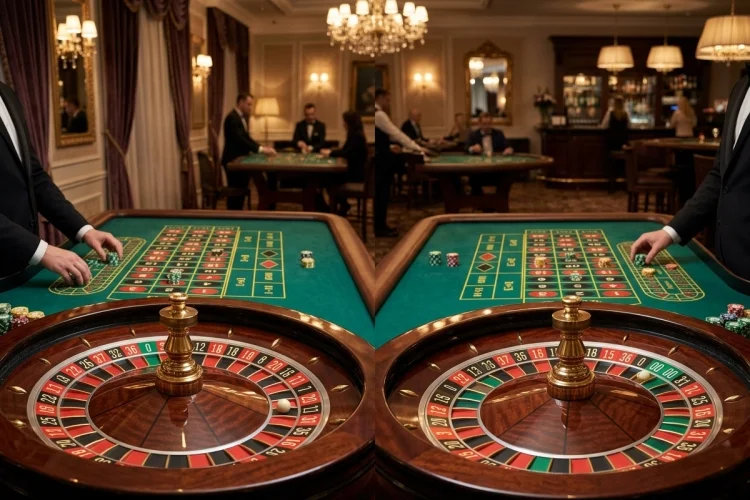
A roulette table can look confusing when you first see it. Numbers, colored boxes, dividing lines, and betting sections seem to cover almost every part of the layout.

The good news is that Roulette Bets become much easier to understand once you separate them into two groups: inside and outside wagers.

Inside options cover individual numbers or small combinations, while outside wagers cover larger sections of the table. The amount paid depends mainly on how many numbers your chip covers.

Bets with fewer winning numbers offer larger payouts, while broader wagers pay less but hit more frequently. None of them guarantees a profit, and every standard option still includes a casino advantage.

How a Roulette Round Works

Before the wheel spins, players place chips on the betting layout. Each chip position shows which number or group of numbers the player wants to cover.

Once betting closes, the dealer spins the wheel and ball. After the ball settles, losing wagers are removed and successful positions are paid according to the table’s payout schedule.

Online roulette follows the same basic process, although the software places and settles the chips automatically.

What Are Inside Bets?

Inside wagers are placed within the main numbered grid. They usually cover between one and six numbers.

A straight-up wager covers one number and pays 35:1. A split covers two adjacent numbers and pays 17:1, while a street covers a horizontal row of three numbers and pays 11:1.

Corner bets cover four connected numbers and pay 8:1. A six-line wager covers two neighboring rows, or six numbers, and pays 5:1.

What Are Outside Bets?

Outside options appear around the numbered grid. They cover larger groups and therefore have lower payouts.

Red or black, odd or even, and low or high each cover 18 numbers and pay 1:1. A dozen covers 12 numbers and pays 2:1, as does a column wager. Zero is not included in standard color, parity, high-low, dozen, or column bets.

These bets may win more often than single-number wagers, but they still lose whenever the ball lands outside the selected group.

Understanding Payout Versus Total Return

A payout ratio normally describes the profit, not the complete amount returned. This distinction is important when calculating winnings.

Suppose you place $10 on number 17 and win. A 35:1 payout produces $350 in profit, and your original $10 stake is also returned. The total amount received is therefore $360.

A winning $10 red wager pays $10 in profit at 1:1, plus the original $10 stake. The complete return is $20. PokerStars’ rules explain that a winning player receives both the listed payout and the original wager.

Why Bigger Payouts Mean Fewer Covered Numbers

A single number pays more because it covers only one possible result. Red pays less because it covers 18 numbers.

On a European wheel, a straight-up wager covers one of 37 pockets. A red wager covers 18 of 37 pockets. On an American wheel, the same bets compete against 38 outcomes because the wheel includes both 0 and 00.

The larger payout does not mean the wager is “better.” It simply reflects its lower chance of winning.

Does Every Bet Have the Same House Edge?

Most standard wagers on the same roulette variant have the same house edge, even though their hit rates and payouts differ. On a normal single-zero wheel, the standard edge is about 2.70%; on a double-zero wheel, it is approximately 5.26%.

One notable exception is the American first-five bet covering 0, 00, 1, 2, and 3. It pays 6:1 and carries a less favorable mathematical return than most ordinary double-zero wagers. New Jersey regulations list the first-five payout alongside other roulette bets.

Read the Table Rules Before Playing

Not every roulette game uses identical conditions. Some single-zero tables offer La Partage, which returns half of an eligible even-money stake when zero appears.

Bally’s published European roulette rules, for example, apply the half-back rule to even-money wagers and list an associated RTP of 98.65%.

Check the wheel type, minimum stake, maximum payout, special rules, and side bets before placing chips. Never assume that familiar artwork means familiar mathematics.

Roulette Bets are divided into inside and outside options. Straight-ups, splits, streets, corners, and six lines cover smaller groups, while colors, dozens, columns, and high-low wagers cover larger sections.

Higher payouts come with fewer covered numbers and lower hit rates. Remember that a listed ratio usually represents profit, with the original stake returned separately after a win.

Before playing, study the layout in free mode, confirm whether the wheel has one or two zeros, and check every payout. Set a fixed entertainment budget and stop when your money or time limit is reached.

Casino Games

European Roulette vs American Roulette: Key Differences Explained

Roulette looks simple from a distance: choose a number or color, wait for the wheel to spin, and see where the ball lands.

However, the version of roulette you select can make a meaningful mathematical difference. The main debate around European Roulette vs American Roulette comes down to one small green pocket.

European wheels contain a single zero, while standard American wheels add a double zero. That extra space changes the probability of every regular wager, even though most payouts remain the same.

Understanding this difference will not guarantee a win. It will, however, help you recognize which table offers the lower long-term casino advantage.

The Wheel Is the Main Difference

European roulette has 37 pockets: numbers 1 through 36 and one green zero. American roulette normally has 38 pockets because it includes both 0 and 00.

The Venetian’s roulette guide confirms that American-style roulette uses the standard 36 numbers plus zero and double zero, while European roulette has only one zero.

That single additional pocket may not look important, but roulette payouts were not increased to compensate for it. As a result, the American wheel gives the casino a larger advantage.

The Betting Options Are Mostly Similar

Both versions allow familiar inside and outside bets. Inside bets cover individual numbers or small groups, including straight-ups, splits, streets, corners, and six lines.

Outside bets cover larger sections of the layout. Common examples include red or black, odd or even, high or low, dozens, and columns.

The standard payouts are also generally identical. A straight-up number pays 35:1, a split pays 17:1, a dozen pays 2:1, and red or black pays 1:1.

European Roulette Has the Lower House Edge

The house edge represents the casino’s expected long-term advantage over the amount wagered. Standard European roulette has an edge of approximately 2.70%.

American roulette normally carries a 5.26% edge on most wagers. The added double-zero pocket almost doubles the casino advantage without improving standard payouts.

This does not mean a European player will lose exactly $2.70 from every $100 session. The figure is a long-term mathematical average based on total wagers, not a prediction for one visit.

Winning Probabilities Change Slightly

A straight-up wager has a 1-in-37 chance of winning on a European wheel, or about 2.70%. The same wager has a 1-in-38 chance on an American wheel, which is approximately 2.63%.

An even-money bet covering 18 numbers wins on roughly 48.65% of standard European spins. On an American wheel, its probability drops to around 47.37%.

These differences seem small during one spin. Across hundreds or thousands of wagers, however, the extra losing pocket becomes more significant.

American Roulette Has a Unique Top-Line Bet

The American layout offers a five-number wager covering 0, 00, 1, 2, and 3. It is often called the first-five or top-line bet.

This wager usually pays 6:1. Because it covers five of 38 pockets at that payout, its standard house edge is about 7.89%, making it less favorable than most ordinary American roulette bets.

Beginners may notice that the bet covers several numbers and assume it is safer. The payout-to-probability relationship is what makes it comparatively expensive.

Special Zero Rules Can Affect the Game

Some single-zero tables offer rules known as La Partage or En Prison. These normally apply to even-money wagers when the ball lands on zero.

Under La Partage, half of an eligible losing wager is returned immediately. Under En Prison, the wager may remain locked for another spin, giving it a chance to be recovered. Such rules can reduce the effective house edge on qualifying even-money bets to approximately 1.35%.

Rules vary between operators, so always read the table information instead of assuming these features are included.

Which Version Makes More Sense?

When both standard versions have the same limits and features, European roulette offers the stronger mathematical choice. It provides the same usual payouts with one fewer house pocket.

American roulette may still appeal to players who prefer its traditional double-zero layout or find it more widely available locally. Preference does not change the underlying probabilities, though.

Whatever version you choose, roulette remains a game of chance. No betting pattern can remove the house advantage.

The central difference in European Roulette vs American Roulette is the number of zero pockets.

European roulette has 37 spaces and a standard 2.70% house edge, while American roulette has 38 spaces and normally carries a 5.26% edge.

Most bets and payouts look almost identical, which makes the mathematical difference easy to overlook. Special single-zero rules may reduce the edge further on certain even-money wagers.

Before playing, check the wheel, table rules, limits, and payouts. Choose a fixed entertainment budget, avoid chasing losses, and stop when your predetermined money or time limit is reached.

Online Slots

Why Ancient Egypt Slots Remain Popular With Online Players

Pyramids, golden masks, mysterious tombs, and powerful gods have appeared in slot games for decades. Even as graphics and mechanics become more advanced, developers continue returning to the same ancient setting.

The lasting appeal of Ancient Egypt Slots comes from a powerful mix of history, mystery, mythology, and adventure.

Players can recognize the theme almost immediately, while developers have plenty of symbols, characters, and stories to work with. Of course, an Egyptian setting does not improve a game’s odds.

Theme and mathematics are separate. Still, when the goal is creating a memorable atmosphere around familiar slot mechanics, Ancient Egypt remains one of the most flexible settings available.

The Symbols Are Instantly Recognizable

Egyptian-themed games usually feature pyramids, pharaohs, scarabs, ankhs, cobras, hieroglyphs, and golden statues. These images are visually distinctive, even for players who know little about Egyptian history.

Many of the symbols also have genuine historical meanings. The British Museum explains that the ankh represented life, while the scarab was connected with the rising sun, transformation, and rebirth. The uraeus cobra was associated with protection and royal power.

That symbolism gives designers more material than simple decoration. A scarab can trigger a transformation feature, while an ankh may represent extra chances or renewed spins.

Treasure-Hunt Stories Fit Slot Games Naturally

Ancient tombs and forgotten temples create an obvious reason for characters to search for treasure. The reels can become a map, vault, burial chamber, or secret passage without requiring a complicated introduction.

Play’n GO’s Rich Wilde and the Book of Dead follows an explorer travelling through Ancient Egypt in search of a mysterious artefact. Its symbols include figures and objects closely associated with Egyptian history and mythology.

NetEnt uses a similar treasure-based structure in Coins of Egypt, which is set around a forgotten temple filled with hidden riches.

Egyptian Mythology Provides Memorable Characters

Ancient Egyptian religion included many gods with distinctive appearances and roles. Anubis is usually shown with a jackal-like head, Horus is associated with the falcon, and Osiris is connected with death and the afterlife.

These characters work well in visual games because players can distinguish them quickly. Pragmatic Play’s Kingdom of the Dead, for example, uses Anubis, pharaohs, and scarabs as major symbols.

Mythology also gives bonus features a clear identity. A god may unlock a reel, transform a symbol, activate free spins, or guide the player into an underworld-themed round.

Gold Creates a Strong Visual Style

Gold appears frequently in Egyptian slots because it is associated with royal objects, jewellery, statues, and famous archaeological discoveries. Dark blue, sandstone, turquoise, and black are often added to create contrast.

The discovery of Tutankhamun’s relatively intact tomb in 1922 attracted worldwide attention, partly because it contained thousands of objects and remarkable golden artefacts.

Developers can use this familiar golden imagery to make key symbols easy to notice. It also creates a luxurious visual identity without needing a modern casino setting.

The Theme Works With Classic Mechanics

Egyptian artwork can be placed around a traditional five-reel layout without making the game difficult to understand. A book, pharaoh, or scarab can serve as a wild or scatter while ordinary card symbols fill the lower-value positions.

This structure appears in games such as Book of Dead, which uses a classic five-reel format combined with free spins and a special expanding symbol.

Because the layout feels familiar, newcomers can follow the basic rules while still enjoying a more detailed theme.

It Also Adapts to New Features

The setting is not limited to traditional paylines. Developers have combined Egyptian imagery with cluster wins, changing reel structures, collection features, and Megaways-style systems.

Pragmatic Play’s Heart of Cleopatra uses a seven-by-seven cluster grid, while Rise of Giza PowerNudge combines Egyptian symbols with its PowerNudge feature.

NetEnt’s Mummy Megaways applies a variable-reel mechanic to a tomb-based adventure.

This flexibility helps the theme survive even when player preferences and game technology change.

Ancient Egypt Slots remain popular because they combine recognizable symbols, mysterious locations, powerful mythology, and treasure-hunting stories.

The theme works equally well with simple paylines and more experimental modern mechanics.

However, visual style should never be confused with better winning chances. Players should still review the paytable, volatility, betting range, and bonus rules before playing.

Explore demo versions where they are legally available and compare how different developers interpret the setting. Choose games for entertainment, establish strict time and spending limits, and stop once either limit has been reached.

Online Slots

Popular Themes in Online Slot Games: From Fruit to Fantasy

Online slots are not only built around reels, symbols, and bonus features. Their themes create the setting, personality, and visual style players notice before they even check the paytable.

Some games recreate old-fashioned fruit machines, while others take players into Egyptian tombs, magical kingdoms, wildlife reserves, or distant galaxies. These settings can make similar game mechanics feel completely different.

The Popular Themes in Online Slot Games are usually based on familiar ideas that can be understood within seconds. However, a memorable theme does not improve the odds or guarantee better results.

It simply makes the presentation more recognizable, entertaining, and easier to follow.

Classic Fruit and Retro Casino Themes

Fruit symbols are among the oldest and most recognizable images in slot gaming. Cherries, lemons, melons, bells, bars, lucky sevens, and jokers immediately create a traditional casino atmosphere.

Modern developers often keep these familiar symbols while adding updated animation, bonus rounds, and more detailed sound design.

Play’n GO, for example, describes games such as Sweet 27, Multifruit 81, and Mirror Joker as modern versions of classic fruit-machine entertainment.

Retro themes remain appealing because they are visually simple. Players can usually identify the important symbols without learning a complicated storyline.

Ancient Egypt and Lost Treasures

Egyptian slots often feature pyramids, pharaohs, scarabs, golden masks, tombs, and mysterious books. The setting naturally supports stories about hidden treasure and dangerous exploration.

Rich Wilde and the Book of Dead is a well-known example. Play’n GO places its fictional explorer in Ancient Egypt, using figures such as Anubis and Osiris alongside tomb imagery and an expanding-symbol feature.

This theme works well because it combines history, mythology, mystery, and adventure. Developers can create dramatic environments without needing a long explanation.

Mythology and Powerful Gods

Greek, Norse, Roman, and other mythological worlds are common sources of slot inspiration. Gods, monsters, magical weapons, and legendary battles give developers plenty of characters and symbols to use.

Pragmatic Play’s Greek Gods sends players to Mount Olympus and builds features around Zeus and lightning imagery. NetEnt’s Divine Fortune similarly uses creatures and stories associated with Ancient Greek mythology.

Mythology also makes special features easy to understand. A lightning strike can transform symbols, while a god’s appearance may activate a bonus or multiplier.

Wildlife and Safari Adventures

Wildlife games commonly use lions, elephants, rhinos, leopards, buffalo, and other impressive animals. They are often placed in jungles, forests, mountains, or African savannahs.

African Elephant from Pragmatic Play includes elephants, zebras, leopards, and rhinos across its reels. The Ultimate 5 uses several large African animals as central characters within a safari-style setting.

Animal themes are flexible because they can feel realistic, dramatic, cute, or humorous. A developer can create a serious nature adventure or a colorful cartoon world using the same general idea.

Fantasy, Magic, and Fairy Tales

Fantasy slots offer enchanted forests, wizards, witches, dragons, castles, and magical objects. These themes give designers the freedom to create completely fictional worlds.

Power of Merlin Megaways uses Merlin, elemental magic, fire, and lightning as part of its presentation and features. NetEnt has also adapted familiar fairy-tale material through games such as Red Riding Hood.

Fantasy themes are especially suitable for progressive visual changes. Reels can freeze, burn, expand, or transform while still fitting naturally within the story.

Space and Science-Fiction Worlds

Science-fiction slots replace temples and castles with rockets, robots, aliens, planets, and futuristic technology. Their visual style often includes neon lighting, electronic soundtracks, and animated characters.

Play’n GO classifies Space Race as a science-fiction video slot built around an interstellar journey. Its Reactoonz-related games have also developed colorful alien worlds and grid-based presentations.

These themes appeal to players who enjoy arcade games, comics, or futuristic movies. They also give developers an excuse to experiment with unusual reel layouts and effects.

Adventure and Exploration

Adventure themes frequently overlap with Egypt, mythology, jungles, and fantasy. The difference is that the main focus is usually a journey, mission, or search for hidden objects.

A strong adventure slot may introduce an explorer, detective, treasure hunter, or hero who guides the player through different features. This can make a bonus round feel like the next chapter of a story rather than a separate screen.

Still, the narrative should never distract from practical information. Players should always check the paytable, volatility, bet range, and rules instead of choosing a game based only on its artwork.

The Popular Themes in Online Slot Games range from simple fruit symbols to detailed worlds based on mythology, wildlife, fantasy, Egypt, science fiction, and adventure.

Each style creates a different mood, even when the games use similar reel mechanics. Themes are mainly entertainment features. They do not change the house advantage or make a winning result more likely.

Before playing, explore a game in demo mode where available, read its rules, and choose a design you genuinely enjoy. Set a strict spending and time limit, and treat every slot session as paid entertainment rather than a method of earning money.

Responsible Gambling

How to Build a Gambling Budget Before You Start Playing

It is much easier to make a sensible money decision before a gambling session begins. Once a game is moving quickly, emotions, near-wins, and the desire to recover a loss can make the original plan easy to forget.

A Gambling Budget is a fixed amount of disposable money that you decide you can afford to lose. It is not a target to spend, and it should never include money needed for bills, food, savings, transportation, or debt payments.

Planning ahead does not make gambling profitable or risk-free. It simply creates a clear financial boundary before excitement begins influencing your decisions.

Start With Essential Expenses

Before choosing a gambling amount, write down your income and necessary monthly costs. These may include housing, utilities, groceries, transport, insurance, debt repayments, and regular savings.

Only consider gambling after these priorities have been covered. GamCare advises that gambling should not be viewed as a way to make money or solve financial difficulties, and it recommends tracking spending as an early step toward managing finances.

When the remaining amount is small or unpredictable, the safest budget may be zero.

Use Disposable Entertainment Money

Treat gambling in the same category as cinema tickets, restaurant meals, or other optional entertainment. The money should be affordable to lose without creating stress afterward.

For example, imagine that you have $150 left after expenses and savings. That does not mean the full $150 should become your betting allowance. You may decide that $20 is comfortable while keeping the rest for other activities or unexpected costs.

The National Council on Problem Gambling recommends using only non-essential income and never risking money reserved for rent, bills, or savings.

Choose a Clear Time Period

A budget works better when it has a defined period. Decide whether the amount applies to one session, one week, or an entire month.

A monthly limit of $40, for instance, does not mean you should deposit $40 every time you log in. It represents the maximum amount available for the whole month.

Shorter limits can also help. Dividing a monthly allowance into smaller weekly amounts may prevent one long session from using the entire budget immediately.

Set the Limit Before Depositing

Many regulated gambling platforms provide deposit, loss, spend, or wagering controls. Use them before making the first payment rather than waiting until the money is already in the account.

The UK Gambling Commission requires operators in its market to provide accessible financial-limit tools and to prompt customers to consider a limit during registration or before their first deposit. Requests to lower a limit must be applied immediately.

Remember that limit names can mean different things. A deposit limit controls money entering the account, while a loss or spend limit may measure activity differently.

Add a Time Budget

Money is not the only limit that matters. Long sessions can reduce awareness of how many bets have been placed or how much has been lost.

Decide how long you will play and set an alarm before starting. When the alarm sounds, log out and review the session rather than immediately extending it.

The Responsible Gambling Council recommends setting both spending and time limits in advance. It also advises taking regular breaks and avoiding decisions while affected by alcohol or other substances.

Never Increase the Budget to Chase Losses

Chasing losses means spending more in an attempt to recover money that has already gone. It often begins with the belief that one more round, spin, or bet will repair the session.

The next result is not guaranteed to be better. Increasing the budget simply exposes more money to the same risk.

Decide in advance that losing the full allowance ends the session. Do not use winnings, borrowed money, or next month’s budget as an excuse to continue.

Track Every Deposit and Withdrawal

Casino balances can make spending feel less real than money leaving a bank account. Keep a simple record showing each deposit, withdrawal, fee, and final result.

Review the total at least once a week. Five deposits of $10 still represent $50, even when each transaction seemed small at the time.

Banking notifications and account statements can support this habit. GamCare also notes that many banks offer gambling blocks or spending controls that can add another layer of protection.

A useful Gambling Budget begins with essential expenses, not with the amount a casino allows you to deposit

Choose a small amount of disposable entertainment money, give it a clear time period, and activate financial limits before playing.

Add a session timer, record every transaction, and stop when either the money or time limit is reached. Never expand the allowance to chase a loss.

Before your next session, write down one affordable number and set it through the operator’s control tools. When following that number becomes difficult, take a complete break and seek support.